Compare Listings

Regarded as the birthplace of the European civilisation, Crete is the biggest, arguably the most beautiful and certainly one of the most fascinating of all the Greek islands. Small wonder it accounts for a quarter of the entire tourist trade of Greece.

It’s the most southerly island in Greece, bordered by the Sea of Crete to the north and the Sea of Libya to the south. You can reach it by ferry but it’s a 14-hour journey from the mainland port of Piraeus. Most package holidaymakers fly into one of the two international airports – at Iraklio, serving the centre of the island, and Hania in the northwestern corner. There’s a smaller airport at Rethymno, at the centre of the northern coastline, which has domestic flights to and from Athens, Rhodes, and Santorini. A third airport is being built at Sitia in the east of the island.
There are plans to replace Heraklion airport with a new one at Kestilli, south of Heraklion. There are monasteries, unspoiled mountain villages, stunning gorges, and magnificent scenery, enough to satisfy the hardiest walker. Despite the arrival of the package holiday industry in force on the island, there are still many lovely isolated spots to tempt the independent traveler.

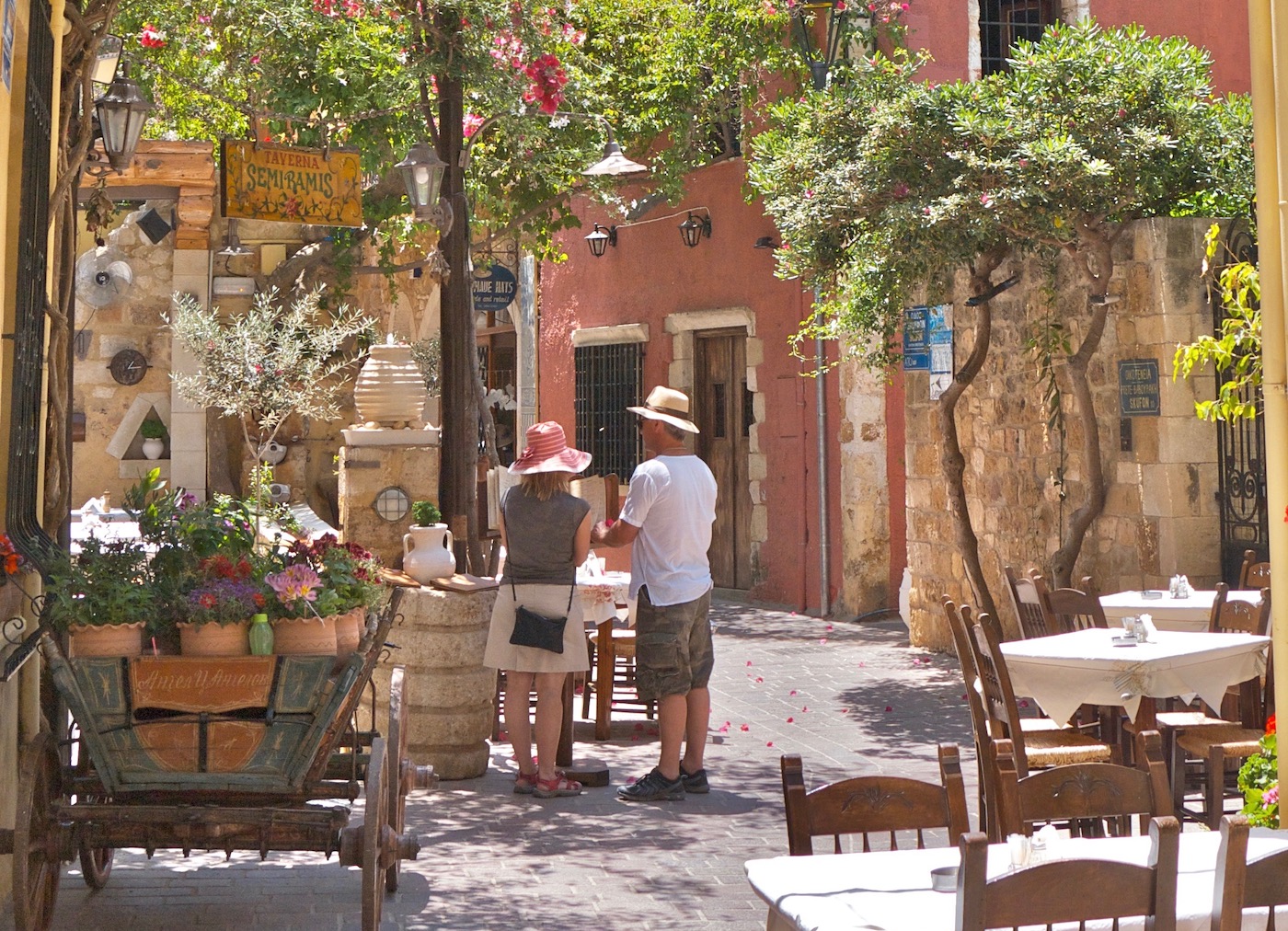
Regarded as the birthplace of the European civilisation, Crete is the biggest, arguably the most beautiful and certainly one of the most fascinating of all the Greek islands. Small wonder it accounts for a quarter of the entire tourist trade of Greece.

It’s the most southerly island in Greece, bordered by the Sea of Crete to the north and the Sea of Libya to the south. You can reach it by ferry but it’s a 14-hour journey from the mainland port of Piraeus. Most package holidaymakers fly into one of the two international airports – at Iraklio, serving the centre of the island, and Hania in the northwestern corner. There’s a smaller airport at Rethymno, at the centre of the northern coastline, which has domestic flights to and from Athens, Rhodes, and Santorini. A third airport is being built at Sitia in the east of the island.

There are plans to replace Heraklion airport with a new one at Kestilli, south of Heraklion. There are monasteries, unspoiled mountain villages, stunning gorges, and magnificent scenery, enough to satisfy the hardiest walker. Despite the arrival of the package holiday industry in force on the island, there are still many lovely isolated spots to tempt the independent traveler.

The secrets of the ancient but highly sophisticated Minoan civilisation lay hidden for nearly 3,000 years until a British archaeologist started excavating the palace site in the early 1900s. The treasures uncovered by his team together represent one of the most important archaeological discoveries the world has ever seen. Where else can you see Europe’s oldest throne, still in its original place, and the en-suite bathroom of a Minoan queen who had the honour of gracing the world’s first-ever flushing toilet?

The biggest sceptic couldn’t fail to be moved by this island where myths, legends, recorded history, and fairy tales have merged into one giant world of irresistible fact and fiction. Only on Crete is it possible to visit the reputed birthplace of Zeus, the king of the Gods.
Modern hotels, apartment blocks and many tourist facilities have sprung up along the northern coastline.
Despite this, Crete’s ancient history and the extraordinary beauty of the island’s diverse landscape, still have their own special magic for you to discover.

The secrets of the ancient but highly sophisticated Minoan civilisation lay hidden for nearly 3,000 years until a British archaeologist started excavating the palace site in the early 1900s. The treasures uncovered by his team together represent one of the most important archaeological discoveries the world has ever seen. Where else can you see Europe’s oldest throne, still in its original place, and the en-suite bathroom of a Minoan queen who had the honour of gracing the world’s first-ever flushing toilet?

The biggest sceptic couldn’t fail to be moved by this island where myths, legends, recorded history, and fairy tales have merged into one giant world of irresistible fact and fiction. Only on Crete is it possible to visit the reputed birthplace of Zeus, the king of the Gods.
Modern hotels, apartment blocks and many tourist facilities have sprung up along the northern coastline.
Despite this, Crete’s ancient history and the extraordinary beauty of the island’s diverse landscape, still have their own special magic for you to discover.

The Minoan Palace of Phaistos, is located in the Messara Plain in south-central Crete, 55 kilometres south of Heraklion and a short distance from the archaeological site of Agia Triada, Phaistos is one of the most important archaeological sites in Crete, with many thousands of visitors annually. “Φαιστός” in Greek It is also written as Phaestos, Faistos or Festos. The Minoan palace of Phaistos was a flourishing city that arose on the fertile plain of the Messara in prehistoric times, from circa 6000 BC to the 1st century BC, as archaeological finds confirm.

Phaistos History
The history of the Minoan palace of Phaistos, like that of the other Minoan palaces of Crete, is a turbulent one. The first palace of Phaistos was built in circa 2000 BC. Its mythical founder was Minos himself and its first king was his brother Radamanthys. In 1700 BC a strong earthquake destroyed the palace, which was rebuilt almost immediately. However, Phaistos was no longer the administrative centre of the area, an honour which passed to neighbouring Agia Triada. Phaistos continued to be the religious and cult centre of south Crete. In 1450 BC there was another great catastrophe, not only in Phaistos but across the whole of Crete. The city of Phaistos recovered from the destruction minted its own coins and continued to flourish for the next few centuries until the first century BC when it was destroyed by neighbouring Gorty.

The Minoan Palace of Phaistos, is located in the Messara Plain in south-central Crete, 55 kilometres south of Heraklion and a short distance from the archaeological site of Agia Triada, Phaistos is one of the most important archaeological sites in Crete, with many thousands of visitors annually. “Φαιστός” in Greek It is also written as Phaestos, Faistos or Festos. The Minoan palace of Phaistos was a flourishing city that arose on the fertile plain of the Messara in prehistoric times, from circa 6000 BC to the 1st century BC, as archaeological finds confirm.

Phaistos History
The history of the Minoan palace of Phaistos, like that of the other Minoan palaces of Crete, is a turbulent one. The first palace of Phaistos was built in circa 2000 BC. Its mythical founder was Minos himself and its first king was his brother Radamanthys. In 1700 BC a strong earthquake destroyed the palace, which was rebuilt almost immediately. However, Phaistos was no longer the administrative centre of the area, an honour which passed to neighbouring Agia Triada. Phaistos continued to be the religious and cult centre of south Crete. In 1450 BC there was another great catastrophe, not only in Phaistos but across the whole of Crete. The city of Phaistos recovered from the destruction minted its own coins and continued to flourish for the next few centuries until the first century BC when it was destroyed by neighbouring Gorty.

Phaistos Excavations
The first excavations in the wider area of Phaistos were undertaken in 1900 by the Italian Archaeological School under Federico Halbherr and Luigi Pernier, continuing after the Second World War under Doro Levi. Most of the buildings visible today belong to the Neopalatial period (1700 – 1450 BC). Unlike Knossos, there have been no efforts at restoration but only conservation.

Touring Phaistos
Follow the paved path next to the car park to the open area in front of the ticket booth. You can buy either a ticket just for Phaistos itself or one including a visit to the archaeological site of Agia Triada, a few kilometers to the west. After the ticket booth is the archaeological bookshop and the refreshment canteen

Phaistos Excavations
The first excavations in the wider area of Phaistos were undertaken in 1900 by the Italian Archaeological School under Federico Halbherr and Luigi Pernier, continuing after the Second World War under Doro Levi. Most of the buildings visible today belong to the Neopalatial period (1700 – 1450 BC). Unlike Knossos, there have been no efforts at restoration but only conservation.

Touring Phaistos
Follow the paved path next to the car park to the open area in front of the ticket booth. You can buy either a ticket just for Phaistos itself or one including a visit to the archaeological site of Agia Triada, a few kilometers to the west. After the ticket booth is the archaeological bookshop and the refreshment canteen